
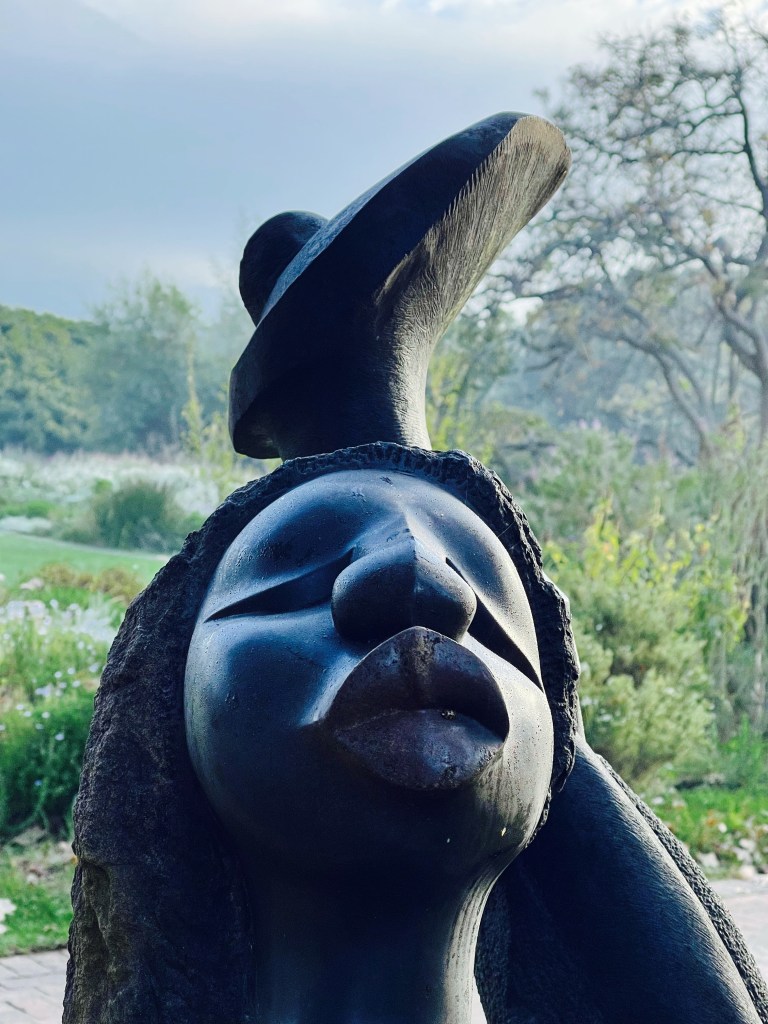
It will always be your softer self that lifts all the heavy of the world sitting on your shoulders.
Always your softer self that can carry the weight of your crown.
Tapiwa Mugabe, 2016
I first learnt of Equanimity from my Meditation Teacher, Sue. Sue features in a lot of stories, so I may as well introduce her early on.
From Sue I learnt how Equanimity fits into the structure of the Theravadan Buddhist Teachings -as a Radiant Abode – and I’ve learnt it’s translation into Pali, “Upekkha”. I’ve learnt that the poem that teaches us best about Equanimity is Rumi’s “The Guest House” (oh, how I despise that poem!) and I’ve learnt that the most consistent way to achieve Equanimity is – as always – more Metta meditation (insert rolling eye emoji here).
The Guest House
This being human is a guest house.
Every morning a new arrival.A joy, a depression, a meanness,
some momentary awareness comes
As an unexpected visitor.Welcome and entertain them all!
Even if they’re a crowd of sorrows,
who violently sweep your house
empty of its furniture,
still treat each guest honorably.
He may be clearing you out
for some new delight.The dark thought, the shame, the malice,
meet them at the door laughing,
and invite them in.Be grateful for whoever comes,
because each has been sent
as a guide from beyond.— Jalaluddin Rumi, translation by Coleman Barks (The Essential Rumi)
Years later I employed my keen Pali vocabulary of approximately 12 words and used “Upekkha” in a sentence with my tuk-tuk driver as we criss-crossed the Temples of Angkor Wat. “Upekkha” used in this way caused great “Muditha” (Sympathetic Joy, another Radiant Abode), as Mr Sokha and I discovered that we were more alike than different, and that one person’s Abiding can be another’s Direction.
“[Equanimity] is evenness of mind, unshakeable freedom of mind, a state of inner equipoise that cannot be upset by gain and loss, honor and dishonor, praise and blame, pleasure and pain. Upekkha is freedom from all points of self-reference; it is indifference only to the demands of the ego-self with its craving for pleasure and position, not to the well-being of one’s fellow human beings.”
Bhikkhu Bodhi
To me, Equanimity has always been the most unattainable of the abodes.
After all, I was always the one afflicted with the Big Feelings and a hunger to be [heard. seen. understood. accepted.]
Equanimity was that one thing I craved that would give me “pleasure and position”. So much of my yearning was directed towards that poised ideal – a version of me who never angered or became frustrated, who never felt envy, who never binge-ate, who would never be swept up by her moods or meanness and be deposited on a different emotional landscape entirely.
And exactly because of that craving, that yearning, that striiiiiiving – it escaped me.
Until today.
Today, on this chilly, chilly morning in Cape Town, wedged between a heater and a hot water bottle, it occurred to me that Equanimity is not something to be attained. It is not something “out there”.
Equanimity is my natural state, that which lives under everything else. It is that which I’m made of, and that to which I can return. It is who I am underneath the drama, the sugar, the exhaustion.
Equanimity is not an outcome based on the successful achievement of the other Abodes. It is their, and my, Guardian.
It is what Sue would call “The Ground of Our Being”.
GROUND
is what lies beneath our feet. It is the place where we already stand; a state of recognition, the place or the circumstances to which we belong whether we wish to or not. It is what holds and supports us, but also what we do not want to be true; it is what challenges us, physically or psychologically, irrespective of our hoped for needs. It is the living, underlying foundation that tells us what we are, where we are, what season we are in and what, no matter what we wish in the abstract, is about to happen in our body, in the world or in the conversation between the two.
To come to ground is to find a home in circumstances and in the very physical body we inhabit in the midst of those circumstances and above all to face the truth, no matter how difficult that truth may be; to come to ground is to begin the courageous conversation – to step into difficulty and by taking that first step, begin the movement through all difficulties – to find the support and foundation that has been beneath our feet all along: a place to step onto, a place on which to stand and a place from which to step.
David Whyte
In this way, when I relax into my hips and feel my body received and supported by the place where I already belong, I am able to carry, with ease, that which rests upon my shoulders.
Strong back. Soft front. Wild heart.

 Daily Braveries